Home / Common Mixing Questions Answered

Common Mixing Questions Answered

By Kevin Eisert,
Sr. Processing Engineer

Mixing may seem straightforward, but selecting the right equipment and optimizing performance can significantly impact product quality, efficiency, and operating costs. From choosing between a static mixer and an agitator to preventing foaming, scaling from lab to production, or troubleshooting vibration issues, the details matter.

In this edition of Ask the Expert, Kevin Eisert, Sr. Processing Engineer at CEJCO, answers some of the most common mixing questions we hear from engineers and plant operators. Whether you’re blending liquids, suspending solids, dispersing gases, or working with shear-sensitive materials, these insights will help you make informed decisions for your application.

General Mixing Questions

How do I know whether I need a agitator or static mixer?
Static mixers are the most cost effective option for blending liquids or gasses in continuous processes for small or moderate flow rates, regardless of viscosity.  In batch applications, at higher flow rates in continuous processes, when long residence times are needed, or when solids are present, then an agitator/rotating mixer is the best choice.


What factors affect mixing efficiency the most?
The two most critical factors in a liquid blending application are the operating volume and the viscosity of the fluids.  When blending solids, the concentration and settling velocity are the two most important parameters other than the volume.


How do I prevent air entrainment or foaming during mixing?
Surface motion directly leads to vapor entrainment, which is the cause of foaming in most applications.  The best way to reduce surface motion without reducing overall mixing is to move the impeller further from the liquid surface, but changing the type of impeller can also impact surface motion and foaming.

Equipment-Specific Questions

How do I choose between a Chemineer or Greerco impeller for my application?

Chemineer mixers are rotating agitators that produce low to moderate shear, while Greerco mixers are high shear devices that run at much higher speeds.  Greerco mixers are ideal for de-agglomerating solids, generating very small droplet sizes when blending immiscible fluids or creating emulsions, while Chemineer mixers are ideal for general liquid blending, suspending solids, dispersing gases and for reactor applications.


Can these mixers handle abrasive or corrosive materials?
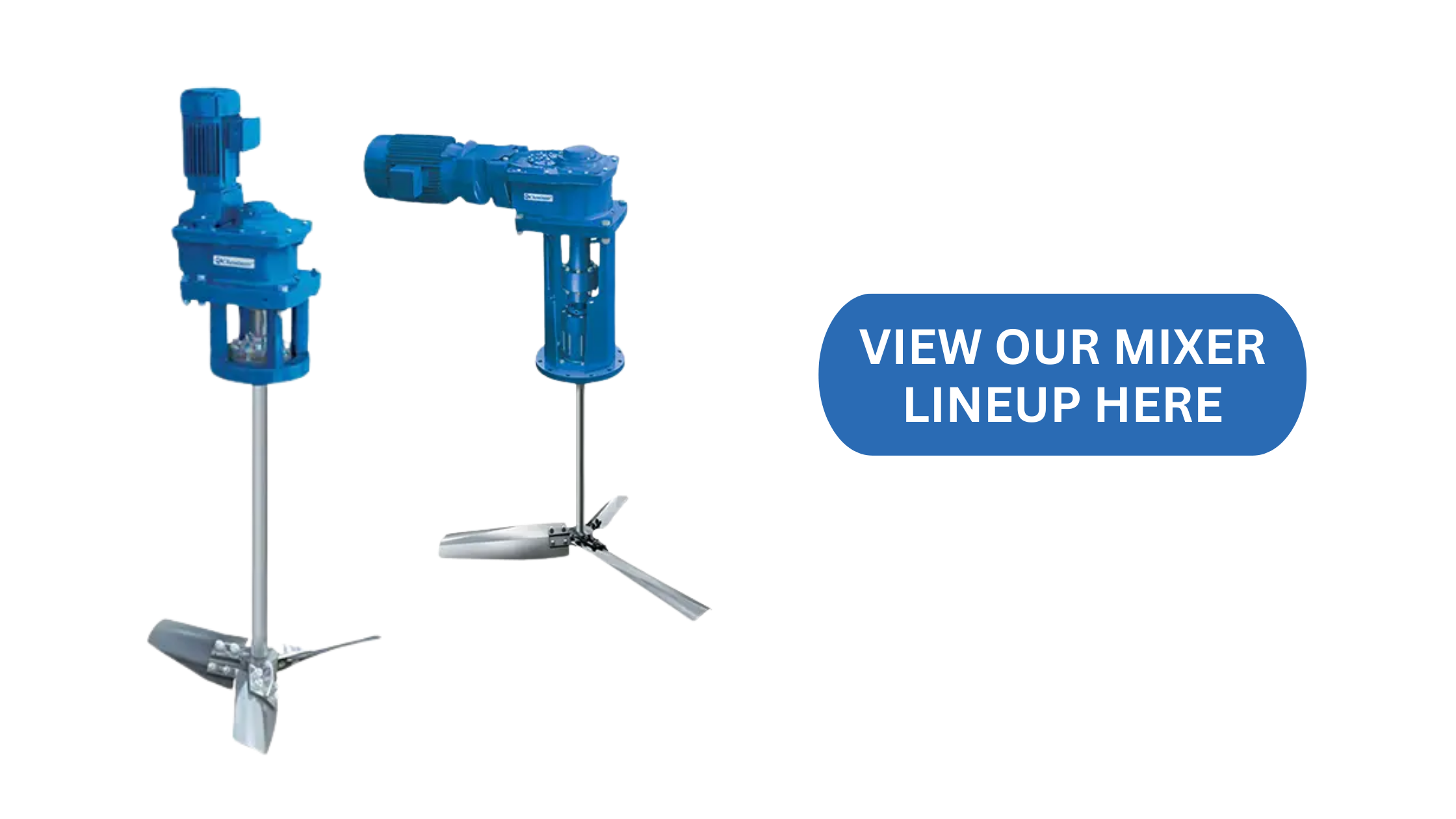
Yes, Chemineer, Greerco, Prochem and Kenics mixers can be designed to handle abrasive or corrosive materials.  In these types of environments, the materials of construction become critical and can be tailored to the specific application.
Industrial mixers to purchase from NOV chemineer, prochem, greerco, and kenics

Process Optimization


What is the optimal tank configuration for uniform mixing?
As a general rule, a 1:1 liquid height to diameter ratio is ideal for liquid blending or solid suspension applications.


How do I scale a mixing process from lab to production?
The ideal way to scale up from the lab to production is to use the same impeller type, use geometric similarity to maintain the same critical ratios (impeller diameter relative to the tank diameter, liquid height relative to the tank diameter, impeller off bottom location relative to the tank diameter) then reduce the speed based on the critical function of the agitator.  The critical mixing functions for which scale up speeds can be calculated are if the same level of fluid motion must be maintained, the same level of solids must be suspended, the same level of surface motion must be maintained, the blend time needs to be matched, or if gases are being dispersed.

Troubleshooting

How can I reduce sedimentation or settling in my product?
If you are seeing solids settling in your tank the simplest change would be to upgrade your impellers.  If an older style of impeller is use in your current tank, then using todays high efficiency impellers, such as the Chemineer XE-3 can significantly improve upon the suspension levels compared to older pitched blade impellers.


What are common causes of mixer vibration, and how can I fix them?
The most common cause of vibration is a weak mounting structure.  If the agitator is nozzle mounted, then adding additional guests or additional reinforcements to the nozzle can stiffen the nozzle and reduce the vibration significantly.  If the agitator is beam mounted, then adding cross bracing will stiffen the structure and reduce the vibration.  Having a stiff structure is not only important to reducing vibration, but it also has a significant impact on the overall life of the equipment.

Application Questions


Can mixers handle shear-sensitive products without damaging them?

Yes, mixers are regularly used with shear sensitive products without issue.  When using a static mixer, the pipe diameter needs to be selected to keep the velocities to a minimum.  When using an agitator, high efficiency impellers should be used and the operating speed needs to be chosen to maintain a slow tip speed.
kevin eisert, sr. processing engineer at cejco

Every mixing application is unique, and small design changes can make a significant difference in performance and reliability. If you have questions about impeller selection, tank configuration, scale-up strategy, or process optimization, the CEJCO team is here to help.

Have a mixing challenge you’d like answered in a future Ask the Expert feature? Reach out to us — we’re always ready to collaborate and find the right solution for your process.